
Understanding Franklin County Releases
Release from the Franklin County Jail means that the sheriff's custody event has ended. It does not always mean the person walked into the community. A person may leave after posting bond, under a judge's order, after serving a local sentence, or through another lawful release. The same roster exit can also mark a transfer to the Tennessee Department of Correction, another county, federal custody, or immigration custody. That difference controls which record to seek next.
The Franklin County Sheriff's Office holds the local booking, movement, and jail-register records. The court holds the judgment, bond, order, and disposition that supplied the legal basis. TDOC becomes the key source when a felony offender enters state custody or community supervision. A federal docket, the Bureau of Prisons locator, or the ICE locator applies only when that separate system took custody. A current jail roster answers who is housed now. It is not a complete archive of Franklin County released inmates.
- Release
- The end of custody by one agency, with or without supervision afterward.
- Discharge
- The completion or formal end of the sentence or supervision described by the responsible agency.
- Transfer
- A move to another custodian, not a return to the community.
- Time served
- A court-authorized end based on custody time credited toward a sentence.
Franklin County Release Paths
The reason for departure should be read from an actual sheriff or court record. A single missing name cannot distinguish among the paths below. Franklin County records may use a release entry, court order, bond record, sentence paper, or movement entry to show what took place. When the sheriff says the person was transferred, ask for the receiving agency and transfer date before choosing another locator.
| Path | What it means | Best next source |
|---|---|---|
| Bond or court order | Local custody ended under bond or a judicial direction. | Jail-register entry plus General Sessions or Circuit Court record. |
| Local sentence complete | The jail served the local term and processed the authorized release. | Release entry, judgment, and sentence calculation. |
| TDOC transfer | The person left the county jail but remained in state custody. | TDOC FOIL and the sheriff movement record. |
| Federal or ICE process | Another government custodian may have received the person. | Federal docket, BOP locator, or ICE locator as applicable. |
Note: A release from one Franklin County custodian may begin custody under a different agency on the same day.
Franklin County Release Record Fields
A release record is usually a linked set, not one universal certificate. The permanent inmate or jail register described in the Tennessee county retention schedule is the most direct local record. It can connect the person's name and offense to the legal process, commitment date, and release date. A separate nonjudicial release order or judgment can show authority for the exit. Booking and movement logs can fill the gap between admission and departure.
| Field or item | What it can establish |
|---|---|
| Name and identifiers | Which person the Franklin County entry concerns. |
| Offense and legal process | The charge or process tied to that custody entry, not proof of conviction by itself. |
| Commitment date | When the recorded local custody period began. |
| Release date and time | When Franklin County custody ended, if both values were recorded. |
| Release type or code | How the custodian classified the exit without replacing the court disposition. |
| Authority or order number | The existing order or legal authority tied to the release. |
| Movement or destination | Whether the exit may have been a transfer rather than community release. |
| Charges and booking photograph | Which booking the release entry connects to and the image held with that file. |
The court record matters because the jail entry may not explain the whole case. A dismissal, bond action, sentence credit, amended judgment, or later order can change the legal picture. Certified judgments and dispositions come from the clerk, not from the subscription portal's informational display. The record should be matched by full name, date of birth when available, booking period, and case number rather than by name alone.
Note: Request the existing Franklin County fields, because the custodian does not have to create a new release narrative.
Request Franklin County Release Records
When the online inmate endpoint does not show history, ask the Franklin County Sheriff's Office for an existing record. Tennessee's public-record framework does not require a custodian to create a new report or answer a research question. A narrow request works best. Name the record, person, date range, and identifiers, and state whether inspection or a copy is wanted. Ask the custodian to cite the legal basis for any denial or redaction.
- Confirm the person and likely Franklin County booking dates. Keep a case or booking number if known.
- Contact the Franklin County Sheriff's Office public information channel and request the existing jail-register release entry.
- Also request an existing release order or movement entry when the release reason or destination is needed.
- Ask whether records can be inspected first and what lawful copy cost applies before ordering copies.
- Use the correct court clerk for a certified judgment, bond paper, or disposition.
494 George Fraley Parkway
Winchester, TN 37398
931-962-0123
The Tennessee guidance says that when prompt production is not practical, the custodian generally has seven business days to produce the record, deny the request in writing with a basis, or give the additional time reasonably needed. Inspection ordinarily has no fee. The statewide model permits standard copy charges of $0.15 per black-and-white page and $0.50 per color page, plus labor after the first hour and delivery costs. These are not a verified Franklin County fee schedule. Ask for an estimate before chargeable work.
The CTAS sheriff retention schedule describes the jail register as permanent. It lists five-year periods for release orders and booking, census, and movement logs. Identification files, including photographs, follow a much longer model period. Franklin County's adopted practice still controls, so identify the record and ask what exists.
Tennessee Law for Franklin Releases
Tennessee Public Records Act guidance explains access to public records for Tennessee citizens, subject to exceptions. TCA §10-7-503 defines public records broadly enough to include photographs and electronic material. A request must be specific enough for the custodian to identify the record. The office need not compile data, conduct research, or create a new release list.
Local retention operates under TCA §10-7-404 and approved schedules. That framework explains how a live roster can lose a name while the permanent jail register remains. Confidential, juvenile, sealed, and expunged content stays protected, and exempt parts may be redacted. TCA §8-4-115 includes a photograph in booking procedure, but it does not create an unconditional right to every image in every case. The agency must apply the records law and relevant exceptions to the requested file.
Note: Tennessee access law supports specific record requests, but it does not override sealed, juvenile, expunged, or confidential status.
Expunged Franklin County Release Records
Tennessee expungement begins in the court where the case arose. When an order covers the record, it can be distributed to the arresting agency, county jail, TDOC, and Tennessee Bureau of Investigation as applicable. State guidance says covered charges are deleted, and TDOC removes covered information from FOIL and its internal offender system. That means later absence can have a lawful records reason.
Do not read a blank search result as proof that no Franklin County booking or release ever occurred. It may reflect a spelling problem, a limited search window, a system outage, a transfer, or an expungement. Use the Tennessee courts expungement guidance for the process, and ask the originating clerk about the status of a particular court record. Juvenile, sealed, and redacted material may also be restricted.
Find Released Franklin County Inmates
Begin with the last known custodian and build an evidence chain. The sheriff's official inmate host was unreachable during the research sweep, and the county site did not publish a distinct recent-release archive. That makes a fallback route essential. The goal is a positive, dated release or transfer record, not an inference from a roster disappearance.
- Check the Franklin County Sheriff's Office inmate link and MobilePatrol for the current listing. Record the date checked.
- Call the jail and ask whether the person is housed, released, or transferred. If transferred, ask which agency received custody.
- Search TDOC FOIL only when state felony custody or supervision may exist.
- Use VINELink for a reported custody event, then confirm that event with the source agency's record.
- Check the proper Franklin court for the judgment, bond, or disposition that explains the legal outcome.
- Use BOP or ICE only when federal or immigration custody is actually involved.
- Request the jail-register release entry when documentary proof is needed.
A released person normally leaves the live jail roster. Absence alone does not distinguish release, transfer, a data delay, or a sealed record.
The county's 24-Hour Release List explains the same-day fallback in more depth. A person who remains in local custody belongs on the current jail route. A former TDOC inmate may remain visible in FOIL with an inactive or supervision status. Federal and immigration systems remain separate.
TDOC Search for Franklin Releases
The Tennessee Felony Offender Information Lookup, called FOIL, covers Tennessee felony offenders. It is not the Franklin County jail roster. Search by name and optional aliases or race, by TDOC number, or by Tennessee SID, then complete the CAPTCHA. A county-only detainee may never appear. If a Franklin County detainee was delivered to TDOC, however, FOIL can show the later state custody or supervision trail.
| Search route | Input | Use |
|---|---|---|
| Name | Last and first name; aliases and race optional | Broad person search when no state number is known. |
| TDOC number | Department-issued identifier | More exact match to the state offender file. |
| Tennessee SID | State identification number | Alternate exact identifier. |
The detail record can include Supervision Status, Assigned Location, sentence length, custody level, sentence begin and end dates, Release Eligibility Date, parole hearing date and result, active sentences, aliases, and a photograph. FOIL warns that dates can change when later court papers arrive. “Release Eligibility Date” is not the same as actual departure, and a parole result is not the final jail gate event.
The official TDOC FOIL overview explains the service. The captured FOIL search screen shows the state fields before any person is selected.
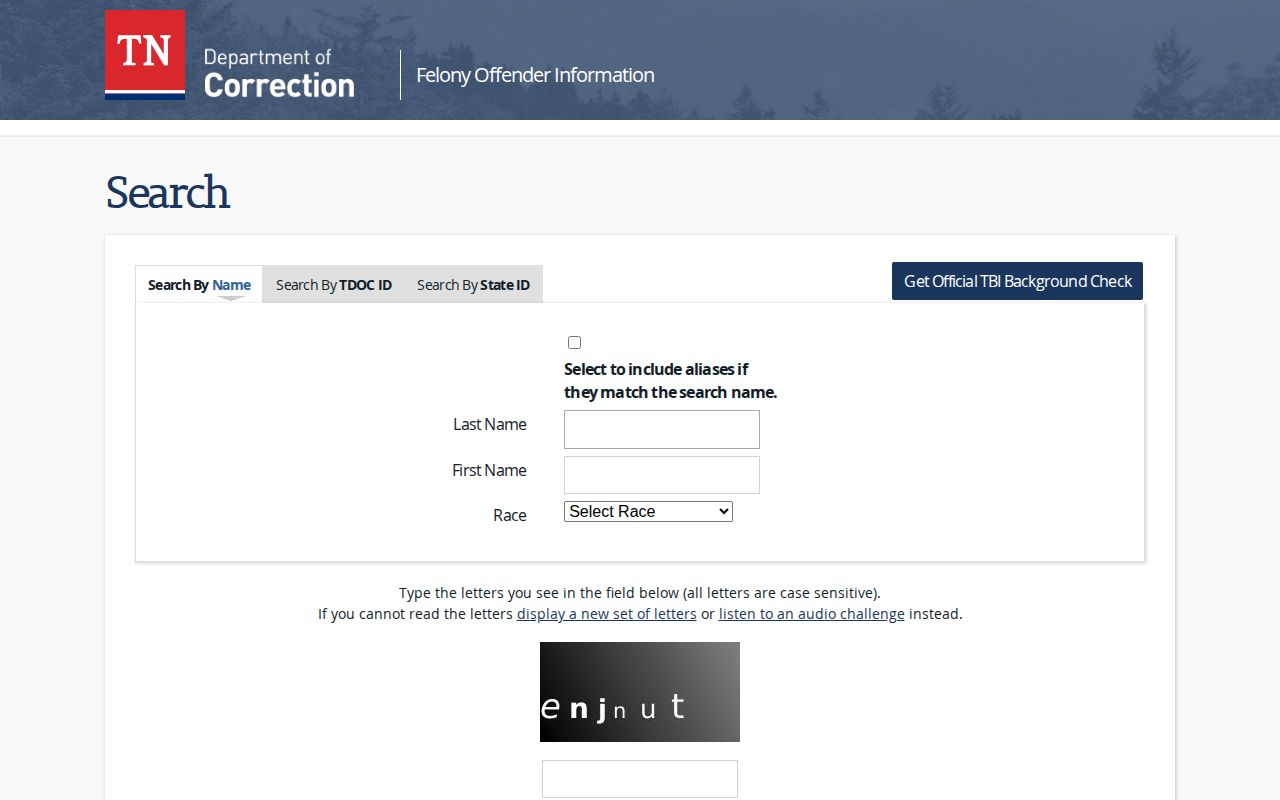
The image reinforces why a state identifier is useful and why a CAPTCHA-protected state search differs from the local jail endpoint.
Note: FOIL covers Tennessee felony records, so a Franklin County pretrial or misdemeanor release may never appear there.
Bond Records and Franklin Releases
Franklin County's clerk site separates Circuit Criminal and General Sessions criminal work and includes Judicial Commissioner and Professional Bonding sections. A General Sessions docket may display a bond field and name a bonding company. Those details can support a possible bond-out explanation, but they do not prove that a bond was posted or that jail staff completed release processing.
The clerk's official site provides the local route, and its published dockets can supply a bond lead. Match any docket bond entry to the sheriff's actual release entry. A bond amount, named company, or scheduled court event is not the same as completed release.
Note: Court authority and physical release are linked events, but the clerk record and jail record answer different questions.
Franklin Courts Explain Release Outcomes
The Franklin County clerk separates Circuit Criminal and General Sessions criminal matters and also publishes Judicial Commissioner and Professional Bonding sections. Select the court that handled the case before asking for a judgment or disposition. A roster exit cannot reveal whether the cause was bond, dismissal, credited time, sentence completion, or transfer.
The subscription portal reports case filings, process, charges, dockets, hearings, attorneys, fees, and payment history. It updates nightly at 8:00 p.m. and lists a $350 annual subscription price. The portal warns that it is not the official court record. Ask the clerk for a certified judgment or disposition, then pair that legal outcome with the sheriff's processed release or movement entry.
Franklin Release Alerts and Transfers
VINELink is the sheriff-endorsed alert layer for a named person. After Tennessee is selected, a person can be searched by name or offender or booking number. Available notifications may include release, transfer, escape, or death. TDOC-related VINE coverage can also address sentence expiration and parole eligibility. A “released” alert shows that a source agency sent a custody event. It does not prove the case ended, supervision ended, or another custodian did not receive the person.
Federal routes should be used only when the facts point there. The BOP Inmate Locator can show federal fields such as register number, age, race, sex, release date, and location. “Released” or “Not in BOP Custody” is limited to BOP custody. ICE has a separate detainee locator, and a U.S. Marshals prisoner may be housed under contract without appearing as a Franklin community release. The relevant federal docket and agency record should be checked together.
- Franklin jail channel
- Use it for current local custody and release follow-up. No verified public release archive was found.
- Jail register
- Use it for dated local release evidence. Access may require a records request.
- TDOC FOIL
- Use it for state felony custody, discharge, or supervision, not a county-only booking.
- VINELink
- Use it for a timely custody-event alert, then confirm the source record.
- BOP or ICE
- Use the matching federal system; neither locator proves the Franklin County release outcome.
Note: Match each alert or locator result to the agency that controlled the specific Franklin County custody event.
Help After Franklin County Release
Middle Tennessee Rural Reentry reports serving eligible adults at the Franklin County Jail since 2007. Its published services include post-release case management, help obtaining identification documents, transportation referrals, probation or parole follow-up, behavioral-health referrals, and follow-up for twelve months. The program lists 494 George Fraley Parkway in Winchester and 931-968-6051. Current eligibility and space should be verified directly with the program.
Case management and agency follow-up are support services, not proof of release or a substitute for supervision. The Franklin County parole and probation page covers the official state route. Middle Tennessee Rural Reentry should be contacted directly about current service availability and eligibility.
Note: Verify current program eligibility directly, because published reentry services do not guarantee placement or control legal supervision.
Identification After Franklin County Release
Middle Tennessee Rural Reentry specifically documents help with identification, birth certificates, and Social Security documents. That is a concrete Franklin County post-release route for an eligible participant who needs replacement identity papers. The program also reports probation and parole follow-up, which can help connect a participant with the correct official office.
This service does not control property returned by Franklin County Jail. No authoritative local jail source established a gate-property procedure, so a reader should call the sheriff rather than assume the reentry program can retrieve personal items. Document help, jail property, and legal supervision are separate requests handled by different sources.
Franklin County Jail Release Context
The Franklin County Jail is the sole county detention facility verified in the official facility sweep. A May 31, 2025 state jail snapshot listed 119 people against 166 beds, or 71.7 percent, and included a TDOC-backup category. That is one dated count. It is not a current roster, an annual release total, or an average stay.
A 2017 construction account described the earlier building as a 1997, 114-bed jail and discussed an expansion designed for 283 at about $9 million. The later official snapshot lists 166 beds, so the historical design figure should not be treated as certified current capacity. This history explains why dates and source labels matter when reading local jail figures.
Franklin County Release Facility
Franklin County Jail at 494 George Fraley Parkway in Winchester is operated by the Franklin County Sheriff's Office. It holds the local custody event and directs current-custody questions to its inmate lookup and MobilePatrol. A community release should leave a sheriff and court trail. A transfer requires the next agency's locator. No TDOC prison, BOP institution, or dedicated ICE detention center was found inside Franklin County in the official sources reviewed.
Municipal police may arrest and briefly hold a person during processing, but the research did not identify a second long-term local jail release database. Trace the booking through the county jail and correct court. Call 931-962-0123 when the online host is unavailable, then request the release or movement entry when a dated document is needed.