
Franklin County VINELink Coverage
VINE stands for Victim Information and Notification Everyday. In Tennessee, the notification layer is also described as Tennessee SAVIN. The Franklin County Sheriff’s Office places VINELink on its own home page under “Victim Notification,” so it is an official county-endorsed route for alerts. County events come from the agency that holds the Franklin County booking. Tennessee Department of Correction events come from the state custody system. Those records can include a change in location, transfer, release, sentence expiration, or parole eligibility when the source agency supplies that event.
Coverage does not make all custody systems interchangeable. A Franklin County Jail booking concerns local custody. A person delivered to TDOC may appear in the state layer even after leaving the county roster. Federal Bureau of Prisons and immigration custody are outside VINELink and require their own locators. The Tennessee Sex Offender Registry is also separate and applies only to qualifying registrants. Start with the agency that held the person, then use VINE as the alert layer over that source.
Note: A Franklin County roster disappearance is only a lead; it does not establish release, transfer time, destination, or legal disposition.
Search Franklin County VINELink
Open the official VINELink search and select Tennessee. Search one person at a time. Name searching is useful, but an offender or booking number is stronger when it is known. Common names can return more than one possible record. Compare every identifier the result makes available before treating it as a match. A spelling change, alias, middle name, or delayed agency update can alter the result.
- Select Tennessee. Confirm the state before entering the person’s details so the search reaches Tennessee participating agencies.
- Enter the name or number. Use the full name as booked, or use the offender or booking number if available.
- Compare possible matches. Check the agency, identifier, age or other displayed traits without relying on the name alone.
- Open the correct record. Read the current custody label, reporting agency, location, and listed event rather than inferring status from absence.
- Record the result details. Note the source agency, exact event label, and time checked so a later update can be compared fairly.
The screenshot below comes from the official VINELink entry point captured for the Franklin County research set.
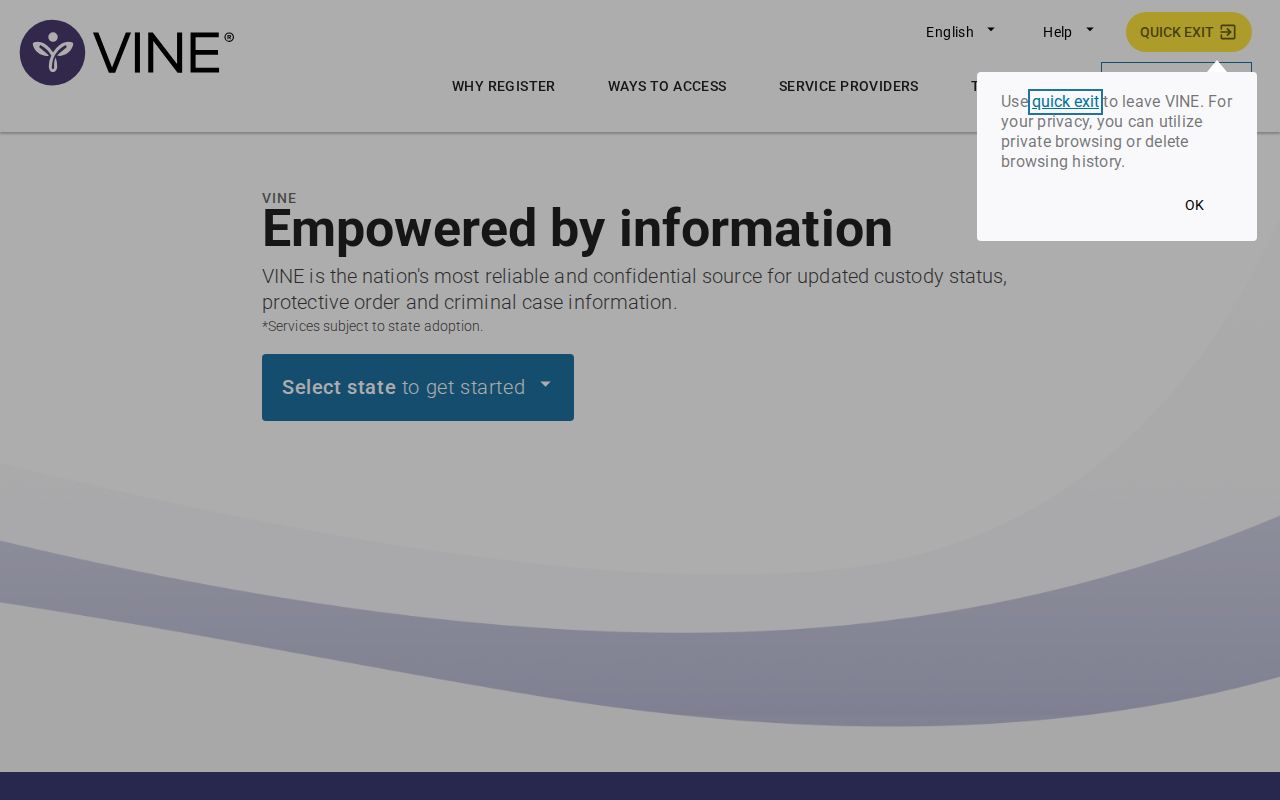
Use that state-selection path before searching. If identity remains uncertain, the broader Franklin County released inmate search path explains how the jail register and court record can resolve the match.
Franklin County VINELink Release Fields
VINELink is built around custody events, not a complete court case history. The exact fields depend on the reporting agency and current record. Tennessee materials support name or offender/booking-number searching and alerts for events such as release, transfer, escape, and death. TDOC’s connected notification system can also address sentence expiration and parole eligibility. A field should be read only within that scope.
| Field or event | What it means |
|---|---|
| Offender name or number | Identifies the searched record; compare it with a stable booking or state number when possible. |
| Source agency | Shows whether the event came from a county agency or the Tennessee state custody system. |
| Custody status | Reports the status supplied by the participating agency at the time of its update. |
| Location or transfer | May show that custody moved. Transfer is not community release. |
| Release event | Shows that the source reported a release-related custody change; it does not prove the case or all supervision ended. |
| Eligibility or expiration notice | For TDOC records, may concern a future eligibility point or sentence expiration rather than physical departure. |
A “released” result does not mean charges were dismissed. It also does not show that parole, probation, or another hold ended. A transfer alert means custody changed hands. Nonappearance is weaker still because a record may fall outside a search window, update late, or come from a system VINELink does not cover.
Read Franklin County Custody Events
The event label must answer the right question. A Franklin County VINE release notice supports the time when the county source reported its custody change. It does not explain whether bond was posted, time was served, a charge was dismissed, or a sentence expired. Those facts come from the sheriff’s release entry and the correct General Sessions or Circuit Court file. The court order supplies legal authority, while the jail register supplies custody processing. Both may be accurate even when their timestamps differ.
A transfer event is clearer about continued custody. If the destination is TDOC, search FOIL after allowing for the receiving system to update. If another county, a federal agency, or immigration authority received the person, use that agency’s locator and record path. Do not convert a transfer into a release simply because the Franklin County roster no longer shows the name. A VINE nonresult is weaker than either event because spelling, an alias, a data window, or a source outage can hide the record.
| VINELink result | Best next confirmation |
|---|---|
| Released | Ask the Franklin County Sheriff for the jail-register release entry and check the court disposition. |
| Transferred | Identify the receiving agency and search its custody system before describing community release. |
| TDOC custody change | Compare FOIL status, assigned location, and the state release record. |
| No result | Retry identifiers, check the source agency directly, and treat absence only as an unresolved lead. |
This evidence order also helps when records update at different speeds. A VINE alert is useful corroboration. A direct agency statement is stronger. The existing jail-register entry, final transfer order, or TDOC release authorization is documentary confirmation. Save the exact label and source instead of rewriting it into a broader claim.
Set Franklin County Release Alerts
Notification is person-specific. Register for the correct Franklin County or TDOC record after matching the identity. The offered channels can include telephone, text, email, or TTY. Each person must be registered separately. More than one contact method can reduce the chance that a changed number or filtered message causes a missed alert.
- Choose notification. Open the matched person’s record and select the registration or notification option.
- Select each available channel. Enter the phone, text, email, or TTY contact information requested for that record.
- Create the phone PIN. A telephone registration uses a private four-digit PIN to acknowledge the automated call.
- Save the registration details. Keep the PIN private and update the registration when a number or email address changes.
- Acknowledge the call. Enter the PIN when prompted. Without confirmation, the system may continue calling for up to 24 hours.
- Verify the event. Contact the reporting jail or TDOC after an alert when documentary proof or the destination matters.
Do not use a switchboard that cannot route an automated call and accept PIN entry. If the PIN is forgotten, Tennessee SAVIN directs callers to 888-868-4631 and option 0. The service also lists TTY help at 866-847-1298. Notification is useful, but emergency services remain the right contact for an immediate danger.
Franklin County Victim Notification
Franklin’s local setup is distinctive because the sheriff presents VINELink beside its inmate lookup and MobilePatrol links. The sheriff’s inmate endpoint did not accept a connection during the August 2026 research sweep. That outage made the county-endorsed alert route more useful, but it did not turn VINE into the county’s permanent archive. The permanent jail register remains the stronger source for an actual local release entry.
The TDOC VINE instructions describe the statewide service and custody notifications. The captured official page below documents that Tennessee layer rather than a private search product.
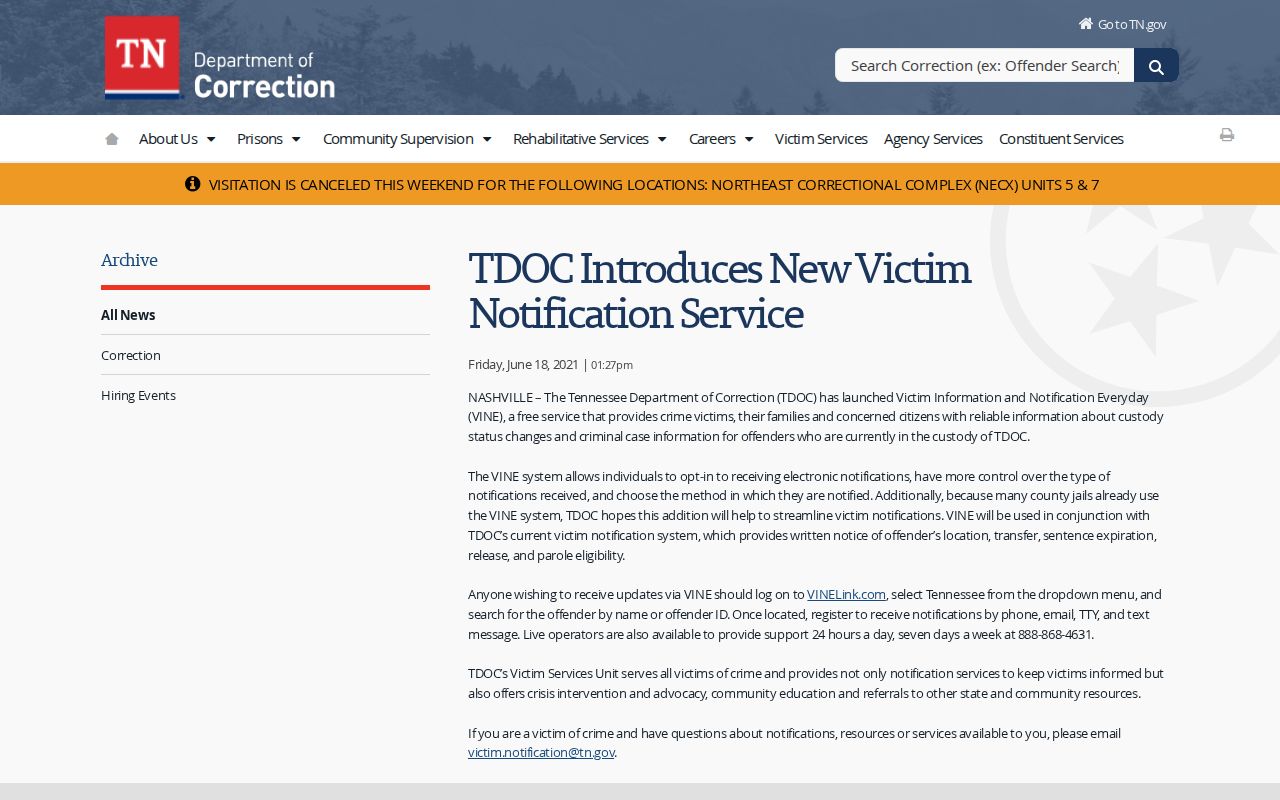
For a Franklin County Jail event, ask the sheriff for the existing release entry or transfer record. For a TDOC event, compare the alert with FOIL and the state release record. That two-source check avoids treating a quick notice as the full legal history.
Alert limit: A VINE notice can arrive before another database updates, and it can report transfer rather than community release. Confirm the exact event with the agency named in the notice.
Confirm Franklin County VINELink Results
The source agency controls documentary confirmation. For a county booking, call the Franklin County Sheriff at 931-962-0123 and ask whether the person is currently housed, was released, or was transferred. When a durable record is needed, request the jail-register release entry and any existing release or movement order. The jail register can state the commitment and release dates, while a movement entry may identify the receiving agency.
For a Tennessee felony offender, use TDOC FOIL. Search by name, TDOC number, or Tennessee SID. Review Supervision Status and Assigned Location. FOIL can also show Release Eligibility Date, Sentence End Date, and parole fields, but those dates have different meanings. A current eligibility date is not proof of release. If the person was delivered from Franklin County Jail to TDOC, loss from the county roster marks transfer, not freedom.
- Release
- The holding agency records that its custody ended under legal authority.
- Transfer
- The person leaves one location while custody continues with another facility or agency.
- Parole
- Conditional community release before the custodial sentence expires.
- Discharge
- The relevant sentence or supervision obligation has ended, which differs from release onto active supervision.
For federal custody, search BOP rather than VINELink. Immigration custody uses the ICE locator. A county alert cannot settle either federal question. Match the custody type first, then confirm the final event through the agency that recorded it.
Note: Record the exact Franklin County VINELink label and check time; later court, jail, or TDOC records may answer a different question.