
Franklin Projected and Actual Release
A projected date is a current calculation. An actual release date records when the custodian processed the person's departure. The two can differ. New court papers, sentence credits, discipline, another hold, a parole decision, or a release-plan problem can change what occurs after the first estimate appeared.
Franklin County Jail and TDOC also serve different groups. A person awaiting trial at the county jail normally has no sentence-based projected date. Bond and court action control, while a detainer may keep custody in place. A locally sentenced person may have a percentage fixed by the court and local credit records. A TDOC felony offender may have public sentence fields in FOIL, even while temporarily housed at the county jail.
A transfer must remain distinct from release. If Franklin County Jail delivers someone to TDOC or another agency, the local roster may lose the name while custody continues. The destination system becomes the next place to check.
Franklin Release Date Labels
Tennessee's FOIL detail record does not use a generic “projected release” label. It displays Release Eligibility Date and Sentence End Date as separate fields. This Tennessee-specific distinction is essential. The Release Eligibility Date, often called RED, is a calculated point for release consideration or the applicable legal release process. It does not assure release that day.
Sentence End Date is the displayed end of the sentence under TDOC's current record. It may be later than the RED. The same detail template includes Sentence Begin Date, Combined Sentence(s) Length, Supervision Status, Assigned Location, Parole Hearing Date, and Parole Hearing Result. FOIL warns that dates may change when later court documents arrive.
| FOIL field | What it answers | What it does not prove |
|---|---|---|
| Release Eligibility Date | When the current calculation reaches an eligibility or release-process point | The actual gate departure |
| Sentence End Date | The displayed end of the sentence | That no supervision or other custody follows |
| Parole Hearing Result | The recorded Board outcome | That release-plan conditions were completed |
| Supervision Status | Current public TDOC custody or community status | The exact historic release time |
The official blank details screen shows these exact Tennessee labels. Open the FOIL details source to compare the public field names.
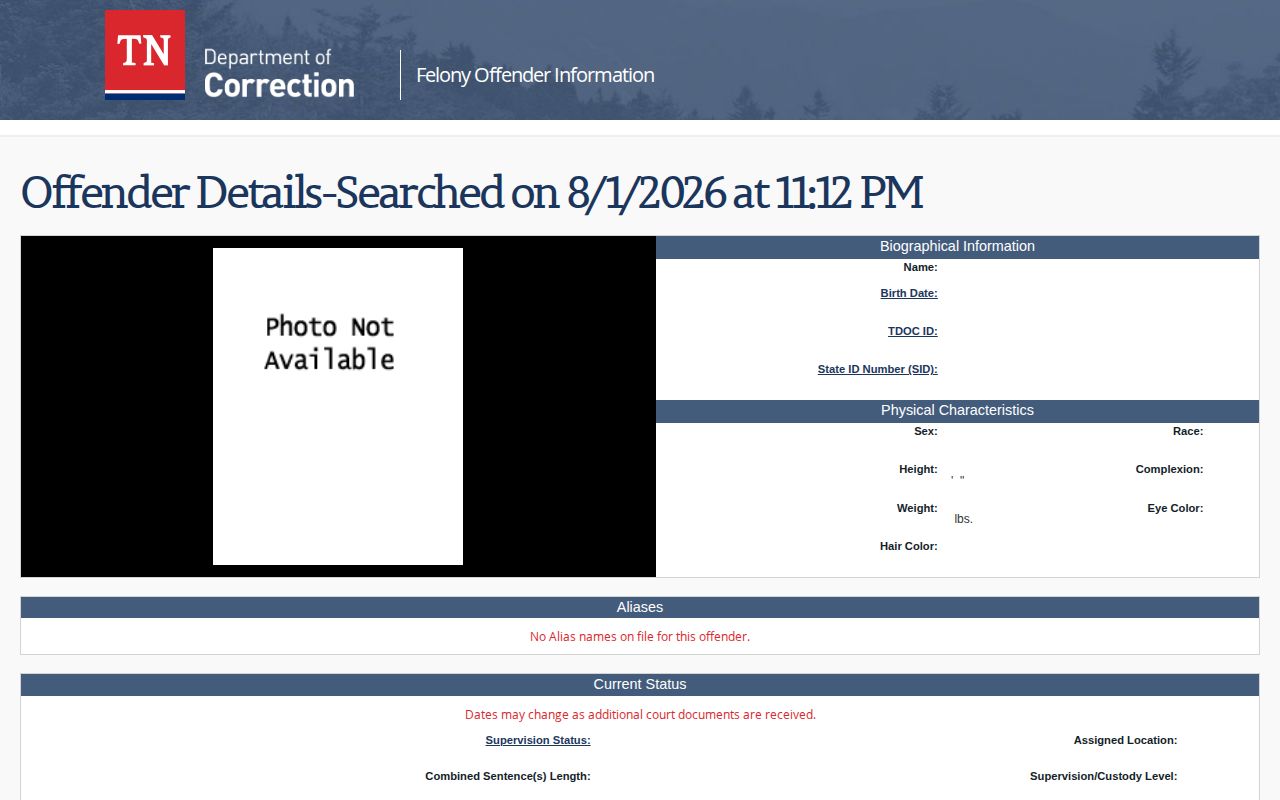
The screenshot reinforces why a universal projected-date label should not replace RED and sentence end in a Franklin County search.
Note: Tennessee FOIL separates eligibility from sentence end, and neither field alone proves the actual departure date.
Find Franklin Projected Release Dates
Start by deciding whether the person is a county detainee, a locally sentenced inmate, or a TDOC felony offender. That choice determines the record. FOIL includes current and former Tennessee felony custody or supervision, but it is not a statewide file of every county arrest, pretrial stay, or misdemeanor sentence.
The county route has three useful channels when no FOIL date applies. The Franklin County Jail can address whether someone is currently held, was processed for release, or was transferred. The jail register supplies the lasting commitment and release entry. The correct Franklin County trial court holds the judgment, amended judgment, bond order, and other sentence documents. Read those records together because an order authorizes action while the jail record shows when custody processing occurred.
- For a TDOC case, open the FOIL overview and follow the direct search link.
- Search by first and last name, optional aliases and race, TDOC number, or Tennessee SID. Complete the CAPTCHA.
- Match the person with identifiers and sentence details. Never accept a common-name result without a second match point.
- Read Release Eligibility Date and Sentence End Date separately. Also note supervision, location, and parole fields.
- For a Franklin County Jail sentence, ask the sheriff for the sentence calculation and jail-register entry, then compare the court's judgment.
- For a pretrial case, check bond, the latest court order, and any hold. Do not invent a projected date where no sentence calculation exists.
- Confirm the actual exit through the final jail or TDOC release record, a VINE custody event, and the relevant court order.
The Franklin County release-record process gives the county jail and records-request route when FOIL is outside the case's scope. A name missing from FOIL may simply mean the person never entered TDOC's felony system.
Note: Record the exact field label and search date because later court documents or credit actions may change a displayed date.
Franklin Release Date Calculation
A sound Tennessee calculation begins with the final judgment, not the arrest charge. Obtain the offense date, conviction offense and class, sentencing range, sentence length, release percentage, and any concurrent or consecutive structure. Concurrent terms run at the same time. Consecutive terms run one after another. Amended judgments can alter the chain.
Next, confirm the sentence begin date and pretrial jail credit. Apply the version of the law that governs the offense and judgment. Use TDOC's awarded or removed credits, not the highest credit someone might earn. Then account for later cases, detainers, pending charges, and new court documents. A detainer is another agency's request to hold or notify before release.
FOIL's RED and sentence end are TDOC's current public calculations. Parole eligibility is only one stage. A Board grant can still await an approved release plan and required conditions. TDOC Policy 511.03 requires authorized release processing, while its sentence-credit policy treats credit changes as record actions. Arithmetic alone cannot establish departure.
The chain is best read in order: Judgment → sentence start and jail credit → governing statute → awarded credits → RED and sentence end → parole or other release process → actual release record.
Franklin Release Percentage Rules
Tennessee has no single rule that every inmate serves 85 percent. TCA §40-35-501 contains several release regimes. They depend on the conviction offense, offense date, sentence length, sentencing range, and statutory exclusions. Some cases use ordinary percentage-based eligibility. Certain serious offenses require 100 percent service, subject to limited credit effects, while other provisions use 85-percent structures. The common “85 percent” shorthand comes in part from rules that prevent credits from cutting some covered terms by more than 15 percent. It cannot be applied to all Franklin County cases.
Always use the conviction offense. An arrest charge can change by plea, dismissal, or trial. The offense date also selects which version of a statute applies. The judgment and amended judgments supply those facts. FOIL then reflects TDOC's public calculation based on documents received.
The TDOC Types of Release page places the eligibility rules within Tennessee's broader release framework. Review TDOC's official release types before treating a percentage as a fixed exit date.
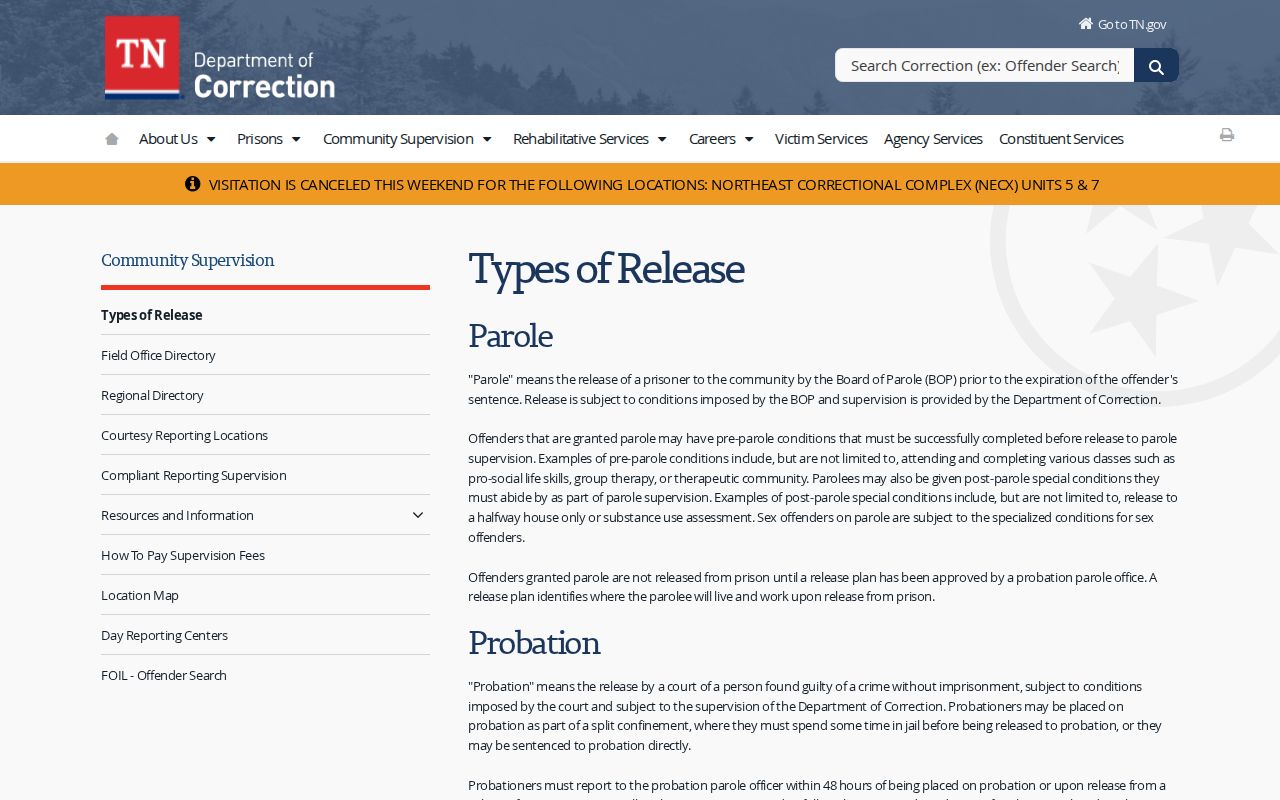
The state source shows that release mechanisms differ, which is why the sentence record and current TDOC calculation must remain tied together.
Note: Apply the statute tied to the conviction and offense date, not a percentage repeated without the judgment.
Franklin Sentence Credits and Release
TCA §41-21-236 authorizes qualifying sentence reduction credits. Under applicable parts of the law, good institutional behavior and satisfactory program work can total from one to sixteen days each month, capped at eight behavior days and eight program days. Awards occur monthly at the warden's discretion. They may be reviewed or removed and are not an automatic right. A qualifying educational achievement can support a one-time sixty-day credit, subject to exclusions.
The rules differ by date and term. For offenses before July 1, 2024, or sentences under two years, credits can affect eligibility and expiration under the statute's detailed terms. For sentences longer than two years for offenses on or after that date, credits affect parole eligibility but do not change sentence expiration. Special 85-percent and 100-percent provisions can impose separate floors.
Some local custody is included. The law addresses felony offenders serving at least one year in a local jail or workhouse. It also permits documented pre-sentence jail behavior credits of up to eight days per month when jail administration recommends them. Misdemeanor rules depend on the court-set percentage and local system. These provisions do not support a guaranteed self-calculated exit date.
Why Franklin Release Dates Change
A projected date can move forward or backward. Some causes affect eligibility, while others block the actual exit without changing the displayed sentence end. The record should identify which event occurred rather than lumping all delays together.
| Factor | Possible effect | Best record |
|---|---|---|
| Credit award or loss | Changes an eligible calculation where the governing law permits | TDOC or jail credit record |
| Later court document | Changes sentence facts, credit, or term structure | Judgment or amended judgment |
| Consecutive sentence | Adds a term that runs after another | Judgment and FOIL sentence details |
| Detainer or pending case | May prevent community release or cause transfer | Holding agency and court record |
| Parole decision | Grant, denial, or rescission changes the release path | Board decision and FOIL fields |
| Release-plan approval | A grant may remain pending until conditions are met | TDOC final release authorization |
Discipline can lead to credit loss under the proper process. A later judgment may add jail credit or change sentence structure. Another agency's hold may turn a planned release into a transfer. Each explanation requires a source record. A date shift should never be guessed from a roster disappearance.
Confirm Franklin County Release Dates
For a state prisoner, compare FOIL with TDOC's final release authorization and any parole release plan. For a locally served sentence, ask Franklin County Jail for the jail-register release entry and sentence calculation, then compare the court judgment. The sheriff's main number is 931-962-0123. The jail is at 494 George Fraley Parkway in Winchester.
VINE can add a timely custody-event notice. Register before the expected date when notification is needed, then verify any alert with the holding agency. The Franklin County VINELink check explains the person-specific search and registration path. A VINE release event is useful support, but the permanent jail or TDOC record is stronger documentary evidence.
Keep four timestamps apart: the judge's order, agency processing, database update, and public posting. The actual release date normally comes from the custodian's recorded departure. A court order can precede jail processing, and a public database can update later. If the person was transferred, record the destination and continue with that agency rather than calling the event a community release.
For an older state case, use TDOC's Archived Record Request and identify the person by full name, date of birth, and TDOC or TOMIS number when known. Ask for the final release authorization, actual date and type, sentence expiration, and any supervision termination. This route can resolve a Franklin County projected release date that no longer appears clearly in a current public result.
Note: The final custodian record controls the actual release date when a projection, court order, and public update differ.