
Franklin Parole and Probation Compared
Tennessee assigns these forms of community control in different ways. The Tennessee Board of Parole makes parole decisions. A sentencing court orders probation. The Tennessee Department of Correction, often called TDOC, supervises both groups in the community. A person may therefore report to the same field-office system even though the legal source of supervision differs.
Parole is conditional release before a custodial sentence expires. A grant does not itself prove that the person left the institution. The release plan and other pre-release conditions must first be approved. Probation is a court disposition. It may replace confinement or follow a period of split confinement. Neither status means the case is discharged.
| Point | Parole | Probation |
|---|---|---|
| Who authorizes it | Tennessee Board of Parole under the governing sentence | The sentencing court |
| Relation to custody | Conditional community release before sentence expiration | A community sentence, sometimes after split confinement |
| Who supervises | TDOC Community Supervision | TDOC Community Supervision for state probation cases |
| Best public lead | FOIL supervision and parole fields | FOIL status plus the sentencing order |
The terms used in a Franklin County supervision record have narrow meanings.
- Parole
- Conditional release from confinement before the sentence ends.
- Probation
- Court-ordered community supervision, with or without prior confinement.
- Discharge
- The formal end of the sentence or supervision obligation.
- Absconder
- An official status for a person alleged to have stopped reporting or left supervision. A missed report alone does not establish it.
Verify Franklin Post-Release Supervision
Begin with TDOC's Felony Offender Information Lookup, or FOIL. Search by first and last name, with aliases and race as optional refiners, or use a TDOC number or Tennessee SID. Complete the CAPTCHA. For common names, compare the identifiers, physical details, aliases, and sentence data before accepting a match.
The detail result separates Supervision Status from Assigned Location. The first can show parole, probation, incarceration, or inactive state involvement. The second points toward the office responsible for an active case. FOIL also lists sentence and parole-hearing fields. Those fields help explain a status, but a hearing result is not the same as physical release.
- Classify the case. A county-only pretrial or misdemeanor case may never appear in FOIL.
- Search FOIL with the most stable identifier available. Do not rely on a name alone.
- Read Supervision Status and Assigned Location together. Note the search date and exact labels.
- Check the sentencing order when probation is involved. The Franklin County trial court controls that disposition.
- Call the assigned TDOC office if the status is unclear. Provide the full name, date of birth, and TDOC or SID number when known.
- Request the final agency or court record when documentary proof of discharge is needed.
For county custody and release evidence, the Franklin County released-inmate search path explains how sheriff, court, and state records fit together. FOIL does not cover every person who left Franklin County Jail.
Note: Match FOIL identifiers before contacting District 50, especially when a Franklin County name has more than one result.
Franklin Parole Office Assignment
Franklin County does not have a TDOC field office listed in Winchester. The official Community Supervision field-office directory assigns Franklin, Coffee, Lincoln, and Moore Counties to District 50 in Tullahoma. That detail matters. A search for a Winchester parole office could lead to the wrong program or miss the state office entirely.
TDOC Community Supervision, District 50
703 Lakeway Place
Tullahoma, TN 37388
Phone: 931-454-1915
Fax: 931-454-1917
The directory did not publish local office hours in the researched material. Call before visiting. Staff may limit personal details, but the office is the proper source for confirming whether an active TDOC record is assigned there. It can also identify the correct office if FOIL reflects a different assignment.
The official directory page shows how Franklin County fits within District 50. View the TDOC field-office directory before relying on an old office address.
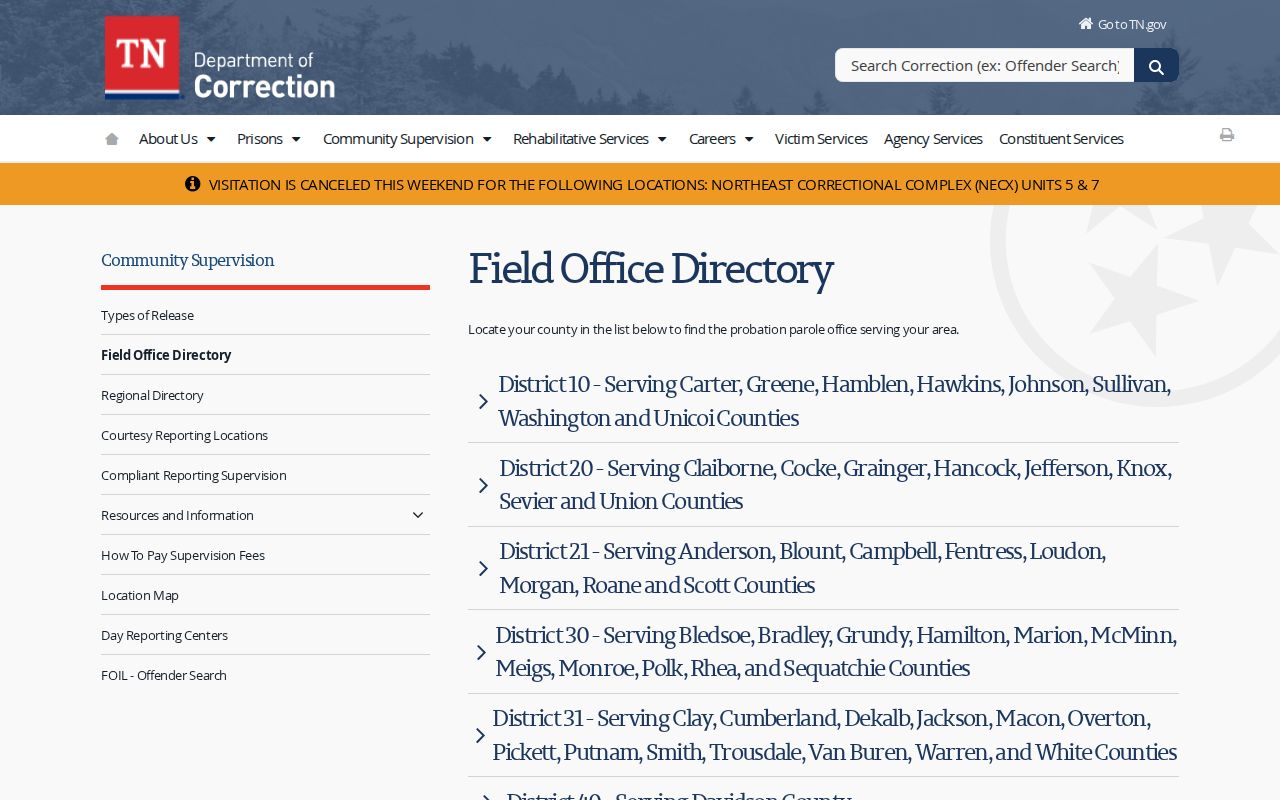
The captured directory provides the state supervision route. It should not be confused with a local court-referral program in Winchester.
Franklin Probation Program Differences
SETHRA Community Corrections operates at 110 2nd Avenue NW in Winchester and publishes 931-962-1913 as its telephone number. It serves qualifying court-referral community-corrections cases in a multi-county area. Community corrections is a court-based prison-diversion placement. It is not the TDOC District 50 parole office.
A person's contact with SETHRA does not prove a Franklin County jail release. The court order must show that placement. Likewise, FOIL may show state probation even when the court file contains the fuller terms. Check the judgment, probation order, or amended order with the court that imposed the sentence. Then use the agency record to confirm current administration.
This distinction prevents a common error. Three local systems can touch one case: the court sets the disposition, TDOC administers state supervision, and SETHRA handles a qualifying court referral. Their records answer different questions.
Note: Ask which agency is legally assigned before sending records or reporting to an address found through an old search result.
Franklin Supervision Status Changes
Conditions are the rules attached to parole or probation. Their exact terms come from the release certificate, supervision paperwork, or sentencing order. A violation is an alleged breach of those terms. It may prompt agency review, a warrant request, a court hearing, or a parole revocation process. None of those outcomes should be inferred from a blank public search.
No official public statewide list for ordinary parole or probation absconders was verified in the Franklin County research. Do not turn a stale address, missed appointment, or missing FOIL result into an absconder claim. Ask the assigned supervision office. Warrant status belongs with the proper court or sheriff channel. The TBI registry has an absconder category only for people within that registry's limited legal scope; it is not a general supervision list.
VINE can send custody events such as release, transfer, escape, or return to custody. It does not certify every parole or probation change. If a violation results in confinement, compare the VINE event with FOIL, the supervising office, and the relevant court or Board record. A transfer means custody changed place. It does not mean community release.
Parole revocation also has its own process. The Tennessee Board of Parole describes preliminary and final revocation hearings, along with rescission and appeal matters. A hearing officer develops facts, while Board action controls the parole result. For probation, the sentencing court record is the key source for a violation filing and final ruling. In either system, an allegation is not the final outcome. Obtain the filed order or agency decision before describing the Franklin County supervision status as revoked, restored, or closed.
Note: A VINE transfer event reports custody movement, not the final ruling on a Franklin County supervision allegation.
Franklin Post-Release Reentry Help
Middle Tennessee Rural Reentry reports serving eligible adults at Franklin County Jail since 2007. Its listed post-release work includes case management, transportation referrals, behavioral-health referrals, probation or parole follow-up, and follow-up for twelve months. The program publishes 494 George Fraley Parkway in Winchester and 931-968-6051.
This help is practical, not legal proof of a supervision status. Eligibility and current availability should be confirmed with the program. A referral does not replace contact with TDOC District 50, the sentencing court, or a parole officer. Still, the service is a specific Franklin County path for people who need help following a release plan and keeping track of agency obligations.
Keep each role clear. Middle Tennessee Rural Reentry provides support. TDOC Community Supervision holds the state supervision record. The court holds the probation order, and the Board decides parole matters.
Franklin Release ID Assistance
The same Franklin County reentry program specifically identifies help with identification, birth-certificate, and Social Security documents. Those records can be needed for routine post-release tasks and for accurate agency contact. The program also lists probation and parole follow-up among its services, which can help a participant reach the correct supervision channel.
No authoritative Franklin County jail rule on property return at the gate was found. The reentry program does not control jail property. Questions about property held by the Franklin County Jail should go to the sheriff at 931-962-0123. Questions about document assistance should go to the reentry program. Keeping those requests separate reduces delay and avoids unsupported assumptions about what happens during release processing.
Franklin Supervision Discharge Records
Supervision ends through a formal agency or court action, not merely because a public record stops appearing. For parole, sentence expiration or a formal discharge ends the obligation. For probation, the court order and agency record control. An inactive FOIL status is a useful lead, but documentary proof should come from the custodian that created the discharge or termination record.
Older TDOC records can be requested through the Archived Record Request. Ask for the final release authorization, actual release type and date, sentence expiration, and supervision termination for the identified offender. Include the TDOC or TOMIS number when known. For a final parole decision, the Tennessee Board of Parole accepts public-record requests and asks for the offender's name and TDOC number.
FOIL may remain the quickest lead, but it is not the only access channel. A probation discharge may be clearest in the Franklin County sentencing file. A parole termination may require the Board or TDOC record. When those sources differ, ask each custodian about the event it controls instead of treating one database field as the whole case history.
Finish the check by separating three events: leaving a jail or prison, serving time under community supervision, and discharge from the sentence. Franklin County parole and probation records may document the middle stage long after the custody roster has changed.
Note: An inactive public status is a lead; obtain the court or agency discharge record for final proof.